
Will it happen?
The new wine landscape with the Mercosur–European Union agreement
Since 1999, Mercosur and the European Union have been discussing a free trade agreement whose main practical measure is to eliminate import tariffs between the two economic blocs over eight years. In the case of wine, this means that if the agreement is signed early next year, the current 27% import tax will be reduced year after year until it disappears in 2033, making European labels much more attractive in price and very likely shifting the balance of power among imported wines in the Brazilian market.
Since 2003, Chile has led the ranking of wine imports to Brazil. It is followed by Argentina and Portugal, which have alternated between the second and third positions in recent years. The Brazilian scenario is quite different from the balance of power among the major wine-producing countries in other markets. According to the latest report from the International Organisation of Vine and Wine (OIV), which brings together more than 50 wine-producing countries, Italy is the largest producer, followed by France and Spain. These countries are giants in both production and export, but here none of them reaches a 10% share of our market, which last year totaled US$ 518 million in wine imports, according to the consultancy IdealBI.
Follow Winext on Instagram!
You can also follow us on Facebook and LinkedIn, and sign our newsletter.

Europe sets its sights on Brazil and increases its presence
The Europeans felt firsthand the urgent need to diversify their foreign sales. In early 2025, the U.S. president set a 50% tariff on European wines. After negotiations, a 15% tariff came into effect. But the pressure was felt. “The threat of U.S. tariffs made countries realize that a free trade agreement is the best path for both blocs,” says Adilson Carvalhal Júnior, director of the importer Casa Flora and president of the Brazilian Association of Beverage and Food Importers and Exporters (BFBA).

"The threat of U.S. tariffs made the countries understand that a free trade agreement is the best option for both blocs.”
Adilson Carvalhal Júnior, director of the importer Casa Flora and president of the Brazilian Association of Beverage and Food Importers and Exporters (BFBA).
And it didn’t take long for Brazil to come into Europe’s sights. Beyond the need to diversify destinations, Brazil appears to the world as one of the few countries showing growth in the consumption of white and red wines—going against global trends—and with a low per-capita consumption, around two liters per person per year. “We are fully aware that a tariff reduction will make Mercosur markets—and Brazil in particular—even more attractive to European producers,” says Frederico Falcão, president of ViniPortugal.
The estimate is that eliminating the import tax would bring a 19% reduction in the final price of imported European wine. The calculation is from Felipe Galtaroça, CEO of Ideal.BI. The reduction is smaller than the 27% import tax because of the cascading effect of other taxes, such as ICMS, which are levied on the total value of the imported wine. The reduction may not be exactly this and will depend on each importing company’s calculation, but it will be significant. Carvalhal, from BFBA, points out that the tax reform currently under discussion in Brazil may change the magnitude of this price reduction. Importers calculate that in the first two or three years, the impact will be smaller, especially because tax cuts will still be modest due to the proposed gradual reduction.

“We are fully aware that a tariff reduction will make Mercosur markets — and Brazil in particular — even more attractive to European producers.”
Frederico Falcão, president ViniPortugal
But the fact is that countries are already organizing themselves for the new chessboard that will take shape with the free trade agreement. Antony Martins, CEO of Grupo Víssimo—which includes the companies Grand Cru and Evino—believes that South American countries, not necessarily Brazil, will be the most negatively affected. “Portugal and Spain should be able to compete with Chilean wines, mainly, and with Argentine wines in a price range where Brazil simply cannot compete,” he says. Currently, Grand Cru’s portfolio is composed of 60% European products and 40% South American, while at Evino the proportion is reversed. For him, it is still too early to calculate how the mix of wine origins will change before the agreement is actually signed. “But we already have our portfolio designed for that moment,” he reveals.
Portugal, in turn, is investing to maintain its leadership among European labels in Brazil. “In 2026, Brazil will be the market with the largest investment from Wines of Portugal. We will maintain a strong presence at major industry fairs and events, continue holding the Wines of Portugal events, promote tastings in various Brazilian cities, intensify promotional actions in supermarkets and wine shops, and strengthen training and qualification programs,” explains Falcão.
Italian critic Marco Sabellico, editor-in-chief of Gambero Rosso—the leading publication on Italian wines—took advantage of his visit to Brazil at the end of November to better understand the local market. The trip was part of the annual roadshow that Gambero Rosso conducts worldwide. However, Sabellico did more than present wines that received the guide’s highest rating, tre bicchieri: he also sought to gather deeper insights into the Brazilian market. “Our producers’ interest in Brazil is growing,” he says, after leading the Gambero Rosso tastings in São Paulo. Of the 59 exhibitors present, 14 were looking for importers. His questions to the audience revolved around how to expand wine consumption in the country and how Italian gastronomy—widely consumed, especially in the South and Southeast—might help increase the presence of Italian wines in Brazil.

“The interest of Italian producers in Brazil is growing.”
Marco Sabellico, Gambero Rosso editor in chief
The South American response: market defense and repositioning
The actions of European players will need to be countered by South American producers, who currently dominate the imported wine market in Brazil. Chile, Argentina, and Uruguay together hold 62.8% of the market, according to Ideal.BI. These countries will have to not only defend their domestic markets from European competition but also secure their presence in Brazil, which is the main destination for their wines.

“Our forecast is to invest 20% more in the Brazilian market in 2026.”
Angelica Valenzuela, Wines of Chile commercial director
In Chile, the decision is to increase investments in the Brazilian market. “We are defining our budget, but the forecast is to invest 20% more in 2026 than in 2025,” says Angelica Valenzuela, commercial director of Wines of Chile. “Our plan is to be even closer to Brazilian consumers and to support our distributors,” she adds. She believes that the arrival of investments from other countries should be positive for the market in the medium and long term, as it expands both supply and wine culture. “More wines will enter Brazil, and this movement will help grow and develop the market,” the executive says.
Argentina also views the agreement as a challenge. “The Argentine wine industry sees the agreement as both a strategic opportunity and a competitive challenge. The gradual elimination of tariffs will create greater competition in the Argentine domestic market and in Brazil, which is the second most important destination for Argentine wine exports,” says Magdalena Pesce, CEO of Wines of Argentina.
In the position since January 2021, when she became the first woman to hold the role, she says that the strategy is to focus on the differentiation and value of the country’s white and red wines. “Our new global communication strategy, ‘Wine for Now,’ is anchored in the pillars of identity, closeness, and personalization. This means we will compete through the uniqueness of our terroirs and by focusing on the premium segment, an area that has proven more resilient to economic fluctuations,” she adds.

“The Argentine wine industry sees the agreement as a strategic opportunity and a competitive challenge. The gradual elimination of tariffs will create greater competition in the Argentine domestic market and in Brazil, which is the second-largest destination for Argentine wine exports”
Magdalena Pesce, CEO Wines of Argentina.
In other words, the defined strategy is to focus on higher-value wines. One example, says Magdalena, is that imports of Argentine wines priced between US$60 and US$84 are growing 8.79%, above the average of other price segments. “Our challenge will not be so much avoiding competition, but rather maintaining and deepening the emotional connection and identity of our wines so that we are not displaced in the value segments by European competitors.”
Brazil’s role and the new competitive landscape
For Brazilian producers, the push toward the premiumization of imported labels may be seen as positive, as competition for consumers would be based on quality rather than price wars. Sensing the imminence of the agreement, Brazilian producers are focusing their strategy on obtaining government measures that bring greater competitiveness to domestic white and red wines. “We just need competitiveness,” summarizes Daniel Panizzi, director of Don Giovanni winery and president of the Brazilian Winegrowing Union (Uvibra).
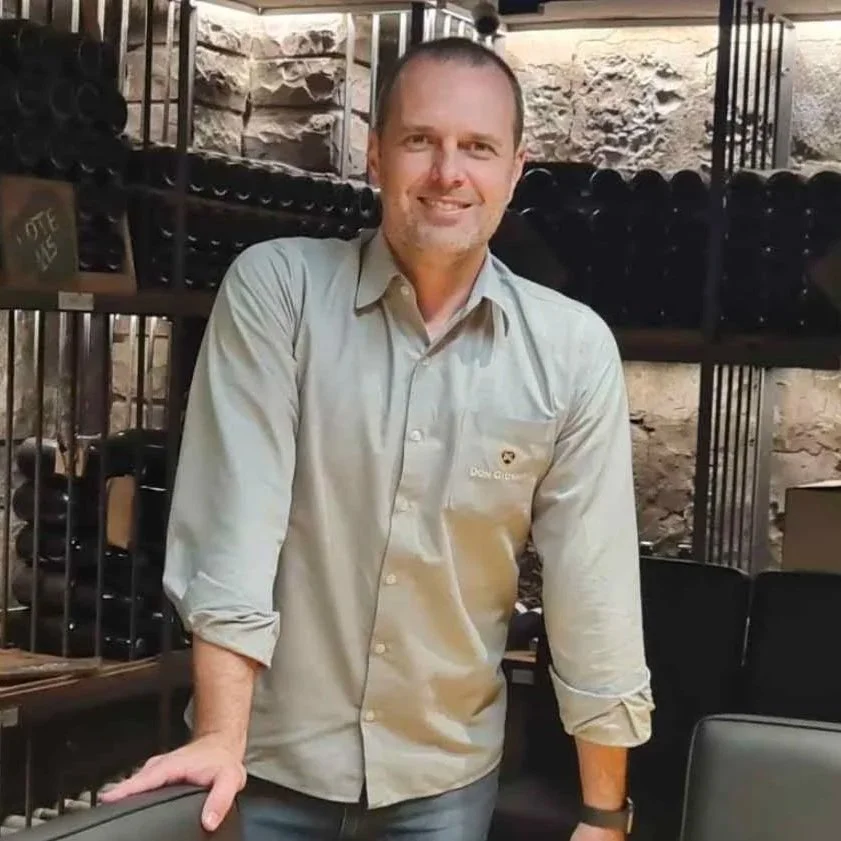
“In Italy, wine is cultural heritage; in Spain, it is considered food. Just like these countries, we need to protect the Brazilian wine sector.”
Daniel Panizzi, director of Don Giovanni winery and president of the Brazilian Winegrowing Union (Uvibra).
The battle for producers, according to Panizzi, is to secure resources that make national production more competitive, such as production incentives, as well as tax incentives, much like the French government provides. According to Uvibra’s calculations, the federal and state taxes proposed in the current tax reform project will together represent 28.5% of the price of wine. “In Italy, wine is cultural heritage; in Spain, it is considered food. Just like these countries, we need to protect the Brazilian wine sector,” the executive says.
Just like a chess match, the board is set for the wine industry, awaiting the start of the game — that is, the signing of the free trade agreement. And it is known that this match is likely to begin soon.
Photo cover: EU flag by Christian Lue on unsplash
Winext helps wine businesses succeed in Brazil. Learn more about our services here.
Follow Winext’s new page on Instagram! You can also follow us on Facebook and LinkedIn, and subscribe to our newsletter.


Luxo não é mais o que era. Esqueça ostentação, logomania e consumo excessivo. Essa reconfiguração representa uma oportunidade clara para o enoturismo, tradicionalmente linear e pouco diversificado.